Exploring flight in the thin Martian atmosphere through aerodynamics, design and flight experiments.
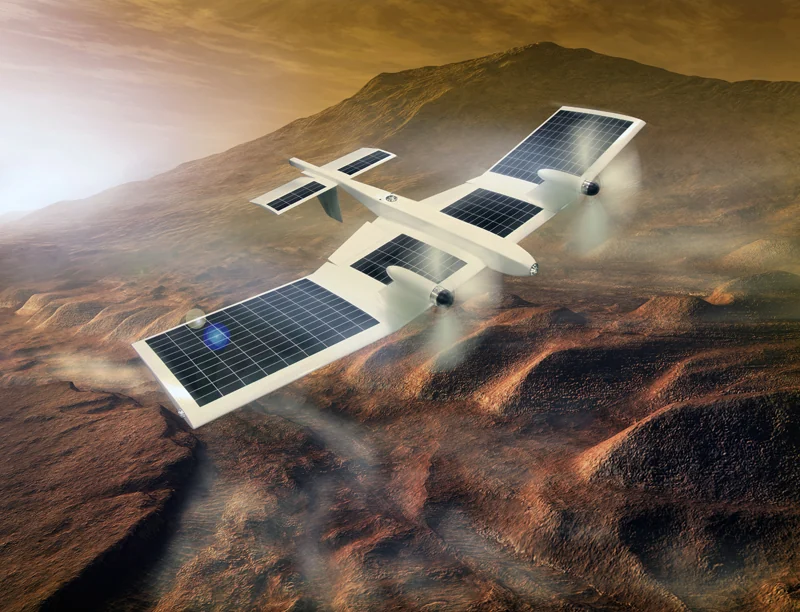
A new perspective on planetary exploration
Mars has a very thin atmosphere. Aircraft that can fly in this environment could offer a way to observe a wide area of the surface in detail, complementing other approaches to exploration.
Our laboratory studies airplanes, helicopters and other aircraft concepts for Mars. We combine computational fluid dynamics with experiments to understand the aerodynamics and design challenges of flight in a thin atmosphere.
Connecting simulation, experiment and flight
Flight on Mars involves a combination of low Reynolds numbers and relatively high Mach numbers. Understanding airfoils and rotor performance in these conditions is essential to developing aircraft designs.
- Aerodynamic analysis and optimization of airfoils and aircraft
- Aerodynamics and flight of helicopters and multicopters
- Conceptual design, flight trajectories and attitude stability
- Validation through wind-tunnel and high-altitude flight experiments

High-altitude flight experiments
Mars airplane flight experiments using JAXA high-altitude balloons were conducted in June 2016 and July 2023. These experiments connect aerodynamic analysis and vehicle design to flight in a real environment.
2016 experiment (ISAS, Japanese) / 2023 experiment (ISAS, Japanese)